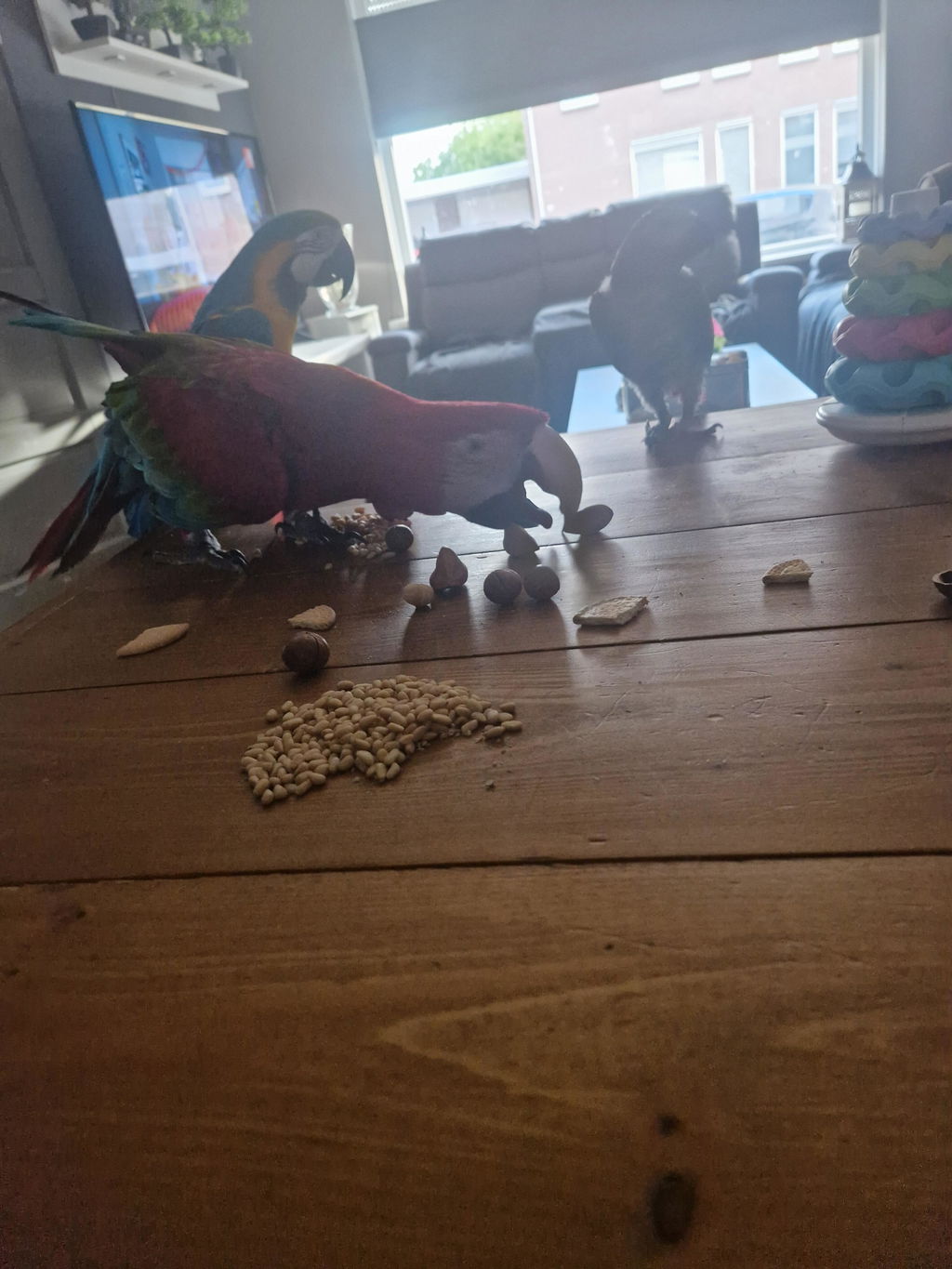
Anyone holding a pili nut for the first time will immediately understand why we score this variety. The nut is hard, three-sided and made up of several layers with small air chambers in between... almost as if nature itself had built a miniature safe around the soft kernel.
For a parrot, that means work to do. The notch provides a starting point, but after that your bird can pick, pry and nibble away until the creamy pili nut finally emerges.
A nut that doesn't give up easily
The pili nut feels very different from a walnut, almond or hazelnut. Not round, not smooth and above all, not simply constructed. Its sturdy, layered shell calls for precise work with beak and feet.
One macaw quickly figures out where the opening is. Another bird first turns the nut around at length, tries different angles and apparently only then decides it is time to get down to serious work.
And even when the kernel has already been devoured, the shell is sometimes not finished. Customers regularly tell us that their parrot happily carries on picking apart and dismantling the shell... one nut, two activities.
Scored... but certainly not ready to eat
The cut makes a naturally very hard nut more accessible, without doing all the work for your parrot. Your parrot still has to open the shell further itself.
That makes this variety interesting for birds that like to hold, pick at and work for something. The activity is simply built around the reward.
A special practical experience with cockatoos
Pili nuts have had a special reputation among some cockatoo breeders for many years. They tell us they like to offer these nuts in the lead-up to breeding season and have had good experiences with them.
We make no claims about its effects or benefits. This is practical experience passed on by bird enthusiasts and breeders... and these are exactly the kinds of observations we find interesting to preserve and share.
What’s in a pili nut?
The edible kernel of the pili nut is naturally very high in energy and fat. Pili also naturally contains plant-based protein, fiber, and minerals such as calcium and magnesium.
With an average of around 70 grams of fat per 100 grams of edible kernel, this is definitely a nut to feed mindfully and in moderation. Just one pili nut can provide quite an extended treat and chewing session.
Pure and natural
Our scored pili nuts are raw, unsalted, and free of added flavorings or oil. The cut in the shell is the only help the nut gets... the rest is up to your parrot.
Like all nuts at Greenparrotshop, these pili nuts are also selected for their consumer-grade quality.
Average nutritional values per 100 g
Energy 2820 kJ / 670 kcal | Fat 70 g | Of which saturated fat 30 g | Carbohydrates 4 g | Of which sugars 1 g | Fiber 8 g | Protein 11 g | Calcium 145 mg | Magnesium 302 mg | Vitamin E 0.6 mg
Nutritional values refer to the edible pili kernel without the shell and are average values. Natural products may vary slightly depending on the harvest and origin.
Ingredients
100% scored raw pili nuts, consumer grade.
Use and feeding advice
Feed in moderation as part of a varied parrot diet. Offer the nut whole and let your parrot work it out from the cut in the shell. Take your bird’s size, beak strength, and experience into account.
Storage advice
Store in a cool, dry, dark place in a tightly sealed package, preferably below 13 °C. Use within 12 months of opening. The pili nuts can also be frozen if desired.
Available in
300 g and 1 kg.
Would you prefer the same special nut without all the shelling? Then take a look at our shelled pili nuts or explore the full collection of nuts for parrots and parakeets.